

Humanizing History
Paper Son: The Inspiring Story of Tyrus Wong, Immigrant and Artist

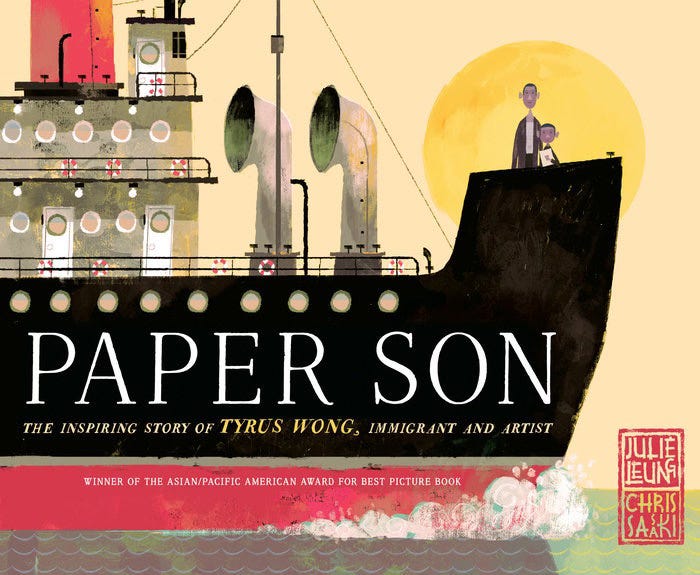
Numerous books about the immigrant experience in America have been written for young people, and surely many stories are yet to be told. Some describe the actual immigration process at various points in our history, the journeys of individuals and families, the settling-in to new communities, the adjustments to life and language in America, the search for a livelihood and perhaps for simple acceptance, and sometimes the attainment of significant success. Others are fictional—placing characters in a story that may be warm-hearted, humorous or searingly sad. Narratives are full of courage as people seek to have a better life than in the place they left. Immigration remains a very confusing issue today. Reading immigrants’ stories humanizes the journey.
In the picture book biography Paper Son: The Inspiring Story of Tyrus Wong, Immigrant and Artist, by Julie Leung, readers learn that Wong Gen Yeo came to the United States with his father, crossing the ocean from China in 1919. Due to the Chinese Exclusion Act of 1882, Chinese immigrants had to prove they were “citizens of high status” to enter the country. His father had taken the name Look Git, claiming to be a merchant, and named his son Look Tai Yow—a “paper son”—providing him papers to memorize, listing answers to all the questions the young boy would need during immigration to certify his relationship to Look Git. He was thus allowed to join his father, who had been in America before.
Gum Saan (“Gold Mountain”—the dream of prosperity and a better life) seemed elusive to Wong Gen Yeo, separated from his father when detained at Angel Island in San Francisco Bay. Eventually they were reunited and began to craft a life. Wong Gen Yeo’s “paper name” of Look Tai Yow was changed at school in Sacramento to Tyrus Wong, combining his real name and his immigrant name.
Knowing how much his son treasured drawing, Tyrus’s father worked hard to send him to an art institute in Los Angeles, where he studied styles of painting and drawing in Western art. “He also studied artwork from China’s Song dynasty, when watercolors and simple lines communicated much by showing little.”
Graduating from art school, Tyrus joined Walt Disney Studios, where he drew backgrounds for the frames used to create animated films. When the studio struggled to create settings for the film Bambi, he realized he could combine his sensibilities in both Eastern and Western art: “Instead of drawing a forest scene leaf by leaf, tree by tree, he created the feeling of woods and mountains with sparse brushstrokes and soft watercolors.” Walt Disney loved his work, and animators were told to follow Tyrus’s style—a style that met with enormous critical and industry success.
Tyrus Wong himself was not credited with success then, but after leaving Disney he continued to make beautiful art—painting on surfaces such as ceramics, scarves, walls and more. His passion in old age was creating enormous kites with colorful images of animals, flying them on ocean beaches. Fortunately, his artistic legacy became well documented over the years before his death in 2016.
An Author’s Note tells more about the practice of “paper” sons and daughters as well as Tyrus’s lasting influence on the art of motion picture animation. In an Illustrator’s Note, animator Chris Sasaki remembers being entranced by the impressionistic brushstrokes bringing Bambi’s forest alive, plus appreciating Tyrus Wong “paving the way for more widespread acceptance of Asian American artists.”
Ages 5-9. Anne Schwartz Books / Random House Children’s Books, 2019.
View video interviews with Tyrus Wong in PBS’s series American Masters.